

What is hallux valgus?
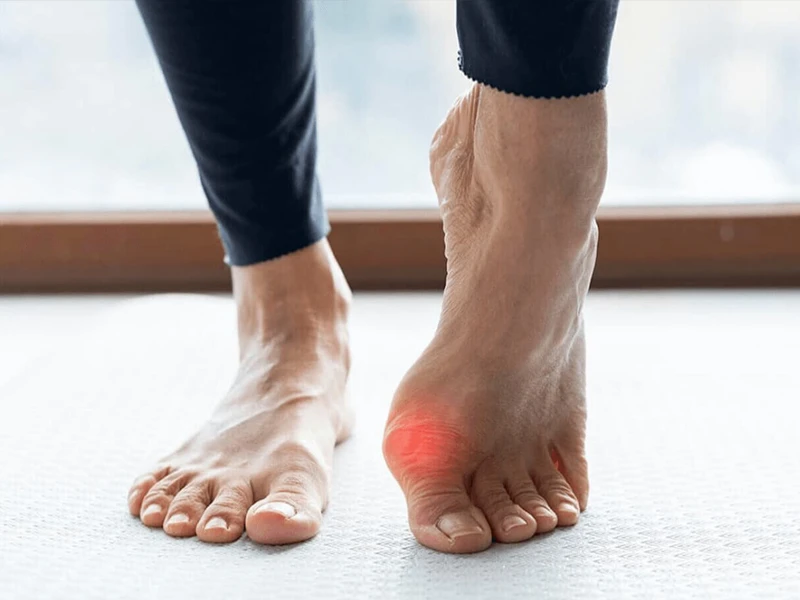
Hallux valgus is the deviation of the big toe towards the second toe, with the base bone of the big toe projecting towards the inner edge of the foot. In everyday language this prominence is called a bone growth; in fact no new bone forms — the alignment of the existing bones is disturbed.
As the deformity progresses the prominence rubs against footwear, and redness and pain develop over it. As the big toe shifts position it becomes unable to carry its load and the load moves to the other toes; this in turn can lead to pain in the sole of the foot and deformities of the toes.
The severity of the complaint is not always proportional to the degree of the deformity. Some people with a marked deformity have few complaints, while pronounced pain can occur with a milder one.
Why does it occur?
It has no single cause; it usually arises through the combination of several factors:
- Foot structure: The inherited shape of the foot is one of the most decisive factors. A similar appearance is frequently found within the family.
- Choice of footwear: Narrow-toed and high-heeled shoes can accelerate an existing predisposition.
- Laxity of the ligaments: Flexibility of the ligaments around the joint makes it easier for the alignment to be disturbed.
- Flat feet and other foot problems: By altering load distribution, they can increase the force borne by the big toe.
Footwear is not a cause on its own, but it can bring out an existing predisposition.
Non-surgical options
Non-surgical approaches do not correct the deformity, but they can help reduce the complaints and slow the progression:
- Change of footwear: Wide-toed, low-heeled models that do not press on the prominence.
- Insoles and in-shoe supports: Measures aimed at regulating load distribution.
- Toe devices and night splints: Aimed at reducing friction and providing comfort.
- Exercise: Strengthening the intrinsic muscles of the foot and preserving range of motion.
Because these methods are aimed at reducing pain, they can be sufficient for a long period in people whose complaints are mild and whose deformity is not progressing.
When is hallux valgus surgery required?
Surgery generally comes onto the agenda in the following situations:
- Pain that persists despite a change of footwear and other non-surgical measures
- A shortened walking distance and restriction of daily life
- Progression of the deformity and the development of deformities in the other toes
- Constant irritation of the skin over the prominence
The aim of surgery is to correct the disturbed alignment. To this end, corrective cuts are made in the bone and the toe is brought into a suitable axis and fixed there. Which method is appropriate is determined according to the degree of the deformity, the wear in the joint and the general structure of the foot.
Examination and treatment process
-
Examination
The degree of the deformity, the tenderness of the prominence, the state of the other toes and the load distribution across the sole are assessed.
-
Imaging
Angles are measured on a weight-bearing X-ray and the wear in the joint is examined.
-
Treatment plan
Non-surgical options are reviewed first; if surgery is required, the method is discussed together with the reasons for it.
-
Follow-up
Footwear advice after treatment, an exercise plan and regular check-ups.
Frequently asked questions
Does hallux valgus correct itself without surgery?
When can I walk after the operation?
Does hallux valgus recur?
Do narrow shoes cause hallux valgus?
Both my feet are affected — can I be operated on at the same time?
Which department should I go to for the prominence on my big toe?

Treating physician
Prof. Dr. Melih Malkoç
Specialist in Orthopaedics and Traumatology. Graduate of Ege University Faculty of Medicine; completed his specialist training at Şişli Etfal Training and Research Hospital and received the title of associate professor in 2015.
Full biography →The information on this page is for general guidance only and does not replace a diagnosis or treatment recommendation. Diagnosis and treatment decisions are made by the physician on an individual basis following examination and imaging.